Configuration
Choose which calendars availability information should be created from.
Once you have connected a calendar product, choose which of its calendars are scanned for availability and how events are imported.
Accessing calendar configuration
- Click your avatar at the top right of the application and choose Calendars.
- On the card of the connection you want to configure, click the Edit icon at the top right.
The Edit connection page opens. It shows the Connection details card and a table of every calendar available on the connection.
Calendar selection
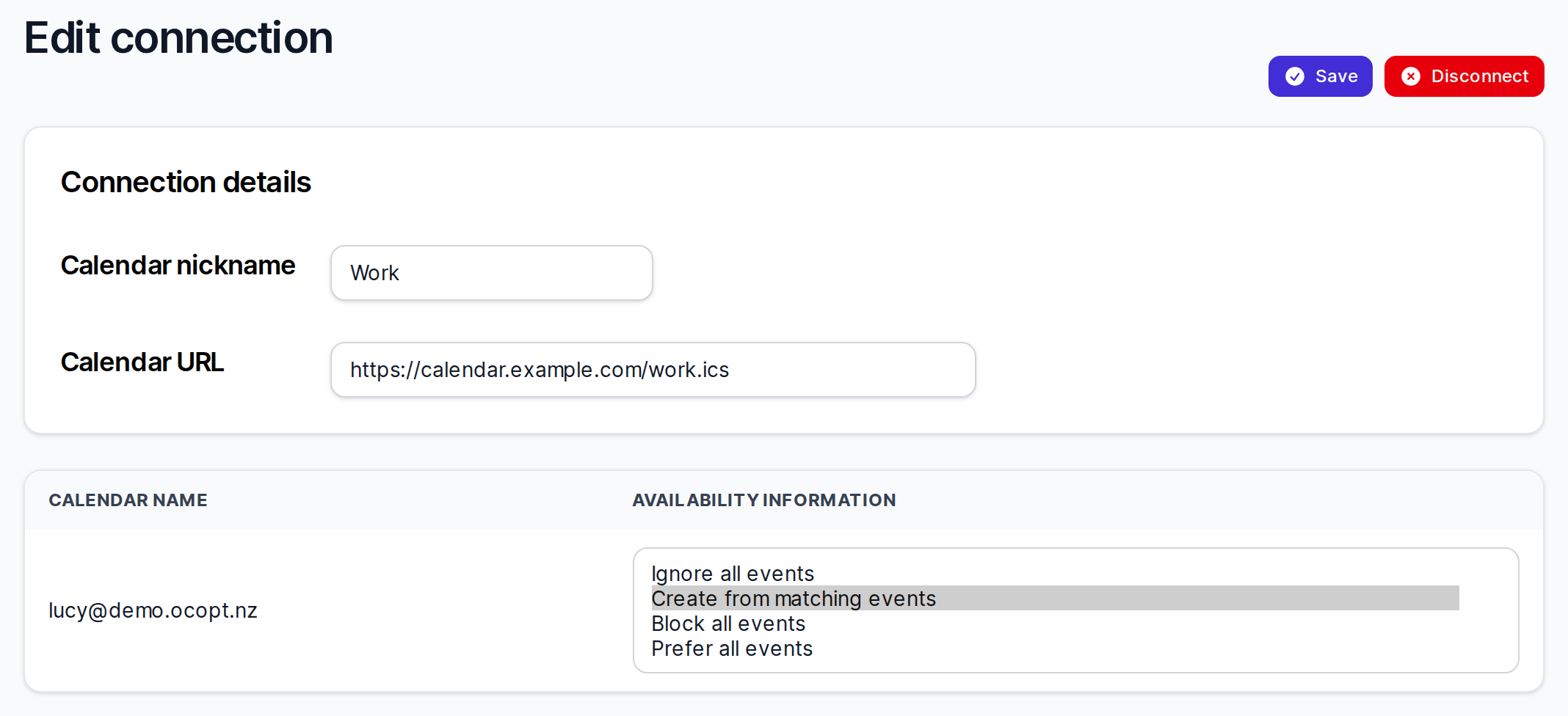
Use the select box in the Availability Information column to choose how events on each calendar are imported, then click Save at the top right of the page. The options are:
Ignore all events
On-Call Optimizer does not process or import any events on this calendar.
Create from matching events
On-Call Optimizer imports only matching events, and uses the
event type or tags (e.g. no-oncall, prefer-oncall) to select the action for the created
availability information.
Block all events
On-Call Optimizer imports every event as availability information with a block action.
Prefer all events
On-Call Optimizer imports every event as availability information with a prefer action.
Default behavior
When you connect a calendar product, these calendars are set to Create from matching events:
- A Google calendar named after your On-Call Optimizer email address. This is your primary calendar when you connect the same Google account you sign in with.
- Your default Outlook calendar, named “Calendar”.
- The calendar in a calendar feed.
All other calendars on the connection are ignored by default. For example, if you connect a personal Google account, no calendar is selected until you choose one. You can enable and configure calendars at any time after the connection is established.
Connection status
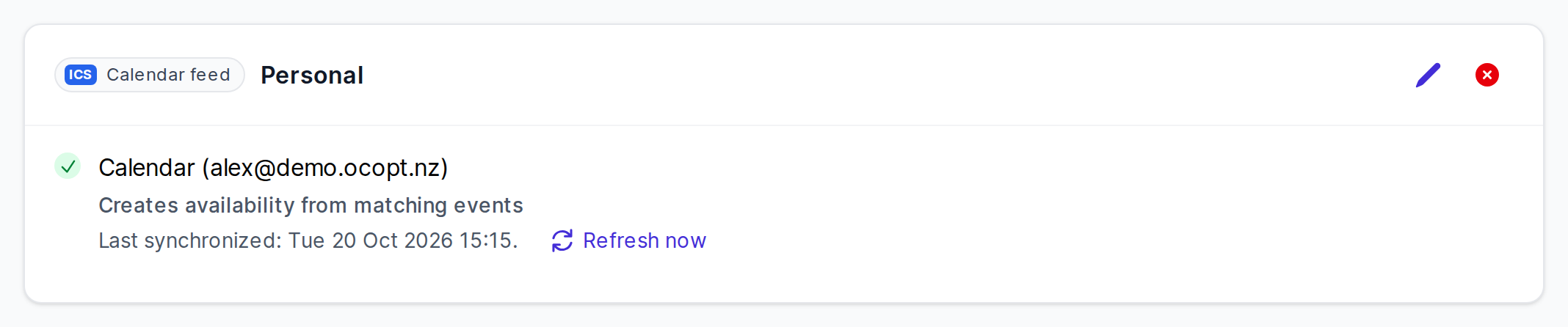
The Connected calendars page shows a card for each connection. For every calendar that is not ignored, the card shows:
- A status dot and the calendar name.
- How events are used, e.g. “Creates availability from matching events” or “Blocks all events”.
- When the calendar was Last synchronized, and a Refresh now button to synchronize it straight away.
Ignored calendars are not listed individually. Instead the card says how many calendars are available but unused on the connection.